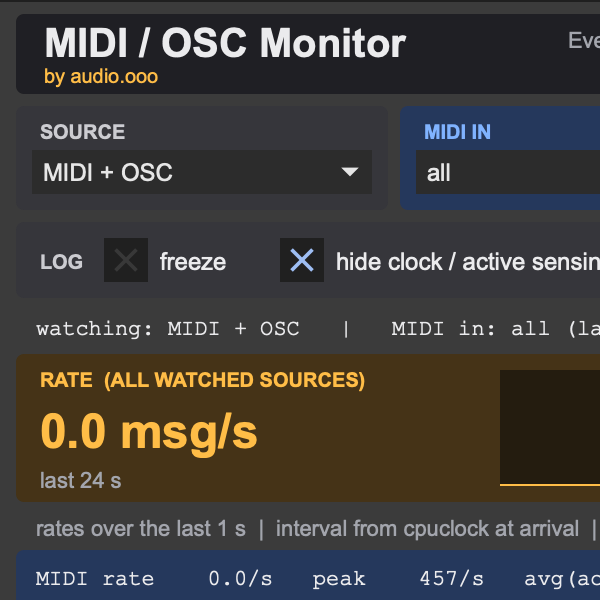
MIDI / OSC Monitor ~ see every message, its rate and its timing
Something sends MIDI or OSC, something else should react, and nothing happens. Or it reacts sluggishly. This patch shows what actually arrives: every message, its rate and how evenly it comes in.
It watches all MIDI inputs (or one) and an OSC UDP port (default 9000) side by side.
Download
Download the patch (zip) with midi-osc-monitor.maxpat, midi-osc-monitor.js and LICENSE. Keep both in the same folder and open the .maxpat in Max 9. The statistics run in a [v8] object, which arrived with Max 9.
What it shows
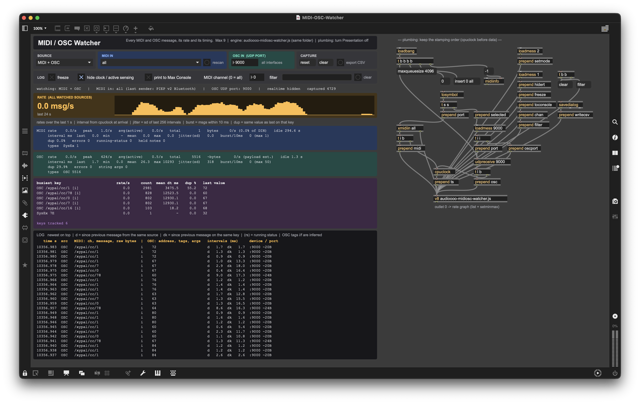
- Log: the newest 24 messages, decoded, with raw MIDI bytes or OSC type tags and arguments. It can be frozen, filtered by channel or text, and exported as CSV.
- Rate: messages per second, with a graph of the last 24 seconds.
- Bytes: for MIDI the share of a 5-pin DIN cable (31,250 baud, 3,125 bytes/s). For OSC an estimate of the payload, without bundle and network overhead.
- Interval / jitter: last, min, mean and max time between messages, plus the standard deviation of the last 256 intervals.
- Burst: messages arriving within 10 ms, for example a device sending all values at once.
- Dup: messages repeating the previous value on the same controller or address.
- MIDI only: running status, errors (stray data bytes, cut-off messages, SysEx without end byte), held notes and the BPM of incoming MIDI clock.
- Busiest keys: the top 7 controllers, notes and OSC addresses by rate.
In the log, d is the time since the previous message from the same source, dk since the previous message on the same key (same CC and channel, or same OSC address).
Good to know
- Timing: every MIDI byte and OSC message is stamped with
cpuclockon arrival, before the JavaScript sees it. Turn on Overdrive so this happens in the high-priority thread. - OSC type tags: Max passes plain numbers to JavaScript, so a float with a whole value like
1.0shows asi. - OSC queue: the queue is set to 4096 messages (
maxqueuesize). A sender bursting beyond that loses messages before Max sees them. - MIDI 1.0 only: Max does not hand MIDI 2.0 packets to patches.
Inside the patch
Leave presentation mode (Cmd+Option+E) to see the objects:
xmidiinreads one or all inputs and reports the device per byte.udpreceivereads OSC.[t l b]passes the message on and triggers the timestamp.cpuclockstamps each message before it is queued for[v8 midi-osc-monitor.js].- The JavaScript decodes MIDI (running status and SysEx included), keeps the statistics and writes the display text about ten times a second.
License
MIT License, Copyright (c) 2026 AUDIO.OOO. The full text is in the LICENSE file included in the download. See also the MIT license.